
Is it 'I burned the toast' or 'I burnt the toast'?
What sounds the most natural to you? Is one more correct than the other? Does one sound more old-fashioned than the other?
And, which one is correct for New Zealand English?
Regular vs irregular verb endings
Regular verbs are verbs that have an -ed ending in the past tense.
climb -> climbed
laugh -> laughed
Most irregular verbs always have a -t ending in the past tense
build -> built (you wouldn’t say 'builded')
However, there are (of course) some that can have either option. And, these often align with differences between American English and British/New Zealand English.
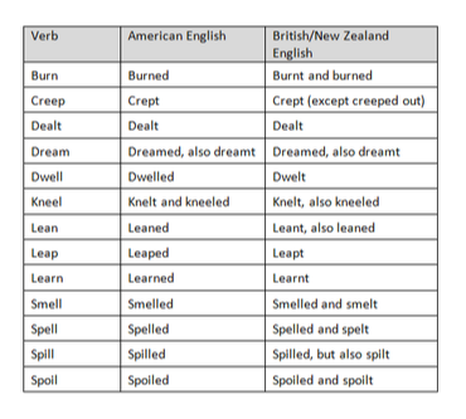
Here is a table of some of the irregular verbs and their preferred endings. These are not hard and fast, as you will see, and people may disagree with the table.
Confused?
You are not the only one.
Looking up the New Zealand Oxford English dictionary doesn’t give us a general rule for which one to use, either. It has 'learned or learnt', 'Burnt or burned' and 'Spelt or spelled'.
In general terms, in British English, traditionally the -t endings have been preferred. Whereas in American English only the -ed version is accepted (except for knelt and dreamt). New Zealand English follows British English.
'I learned French' – American English and acceptable in British/New Zealand English
'I learnt French' – Most common in British/New Zealand English
But today there are a few verbs that can have either in British English, or they have moved completely to -ed. Language is always changing and it appears that British English is starting to move towards more -ed endings.
Below is an ngram graph which takes words from millions of online books and compares the percentage of times each is used over time. Below, burned and burnt are compared in British English from 1800 to 2000.
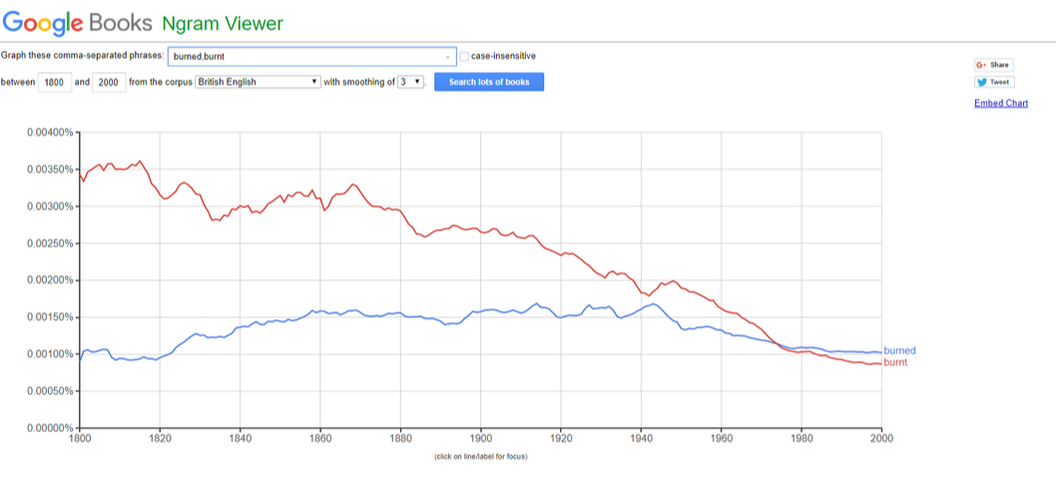
As you can see, it used to be much more clear cut to use burnt, and only very recently burned started to take over.
Rules?
There are several theories of rules on where to use which ending, but again, these which are very subjective and may not work in all situations.
For example, that you would use -ed in the past tense and -t endings as the past participle
I learned French at school – past tense
I have learnt French but forgotten it – past participle
Or, that it depends on whether the duration of the action is important or not.
The fire burned for days – duration important
She burnt her finger – not important
As adjectives
One rule that does seem fixed is that when the root is used as an adjective, the verb ending is fixed.
burnt toast
spilt milk
spoilt child
learned person (pronounced learn-ed)
So, what does this tell us?
It tells us that traditionally, and most of the time, -t endings were preferred in British (and therefore New Zealand) English. But it also tells us that this is changing (and there will be all sorts of theories on why).
So, in your writing, you get to choose.
But, as always, make sure you make it consistent. Either follow the ‘rules’ or choose one ending style and stick with it in all your content.
What next?
If you have written content in New Zealand English and this all sounds overwhelming, I can help.
As a business editor and plain language specialist, I will help you publish better business and government content so that
your readers understand your message
your business works more efficiently
your clients trust you.
Contact me today to discuss how I can help you achieve your goals with clear, professional writing.